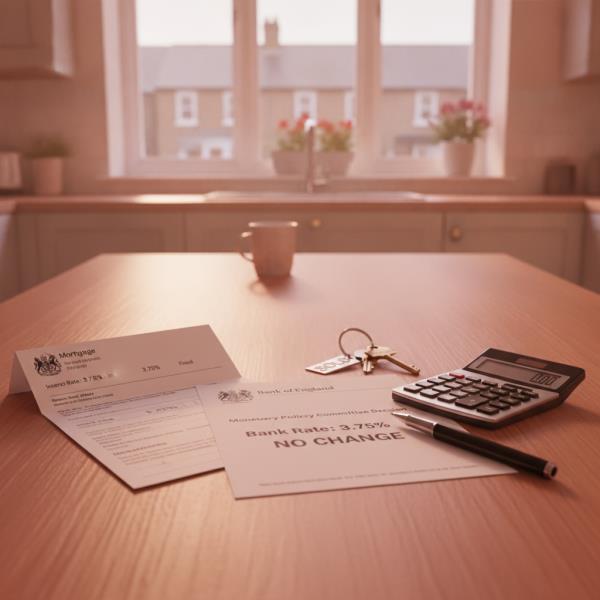
Bank of England Holds at 3.75% - What It Means for Your Mortgage
The Bank of England held the base rate at 3.75% in June 2026, but mortgage costs remain well above that figure. Understanding the gap between base rate and what lenders actually charge, and acting quickly could save you thousands over your mortgage term.
The Bank of England's Monetary Policy Committee voted on 18 June 2026 to hold the base rate at 3.75%. For anyone buying, remortgaging, or watching their current deal expire soon, that headline figure tells only part of the story. The rate you actually pay depends on a different set of forces — and knowing how those work gives you a real advantage when choosing your next mortgage.
Why Your Mortgage Rate Is Not 3.75%
The base rate is the rate at which the Bank of England lends to commercial banks overnight. It influences borrowing costs across the economy, but lenders do not simply pass it on directly to mortgage customers.
Standard Variable Rates (SVRs) the rate you revert to when a fixed or tracker deal ends are currently averaging above 7%. That is not a typo. Lenders set SVRs at their own discretion, and they tend to move slowly and stay high. If your fixed deal expires in the coming months and you take no action, you could find yourself on a rate more than double the base rate.
Meanwhile, the best five-year fixed deals currently sit in the range of roughly 4.55% to 5.07%, while competitive tracker mortgages are available near 3.96%. These are meaningfully lower than SVRs, but still well above the base rate itself.
Swap Rates: The Real Driver of Fixed-Rate Pricing
If fixed rates are not tied directly to the base rate, what sets them? The answer is swap rates — the rates at which banks agree to exchange fixed and variable interest payments over a set period in financial markets. When lenders price a five-year fix, they are essentially hedging against future rate movements using five-year swap rates.
Swap rates reflect market expectations about where interest rates will be over time, not just where they are today. This is why fixed mortgage rates can rise or fall sharply even when the base rate stays still. A shift in economic data, a change in inflation expectations, or turbulence in global bond markets can move swap rates and therefore mortgage pricing within days.
During recent periods of market volatility, some lenders pulled sub-4% tracker and fixed deals within 48 hours of launching them. If you see a rate you want, waiting to act can mean the deal disappears.
Fixed Rate or Tracker: Which Is Right for You?
Both product types suit different circumstances. Here is a straightforward breakdown:
- Five-year fixed rate: Suits buyers who want certainty over monthly outgoings. You know exactly what you will pay for the duration of the deal, regardless of what happens to rates. Best for those stretching their budget, starting a family, or simply preferring predictability.
- Two-year fixed rate: Offers lower rates than five-year fixes in the current market, but you will need to remortgage sooner, exposing you to whatever rates look like in 2027 or 2028. Useful if you expect to move or overpay significantly within that window.
- Tracker mortgage: Moves in line with the base rate, typically expressed as base rate plus a margin. With trackers near 3.96%, buyers who expect the base rate to fall further could benefit. The risk is that if rates rise, so does your payment. Check whether the tracker has a cap, and whether it has early repayment charges if you want to switch later.
LTV Thresholds: Why Your Deposit Size Matters
Lenders price mortgages in bands based on your loan-to-value ratio (LTV) — what you are borrowing as a percentage of the property's value. The better rates quoted above typically require a deposit of at least 25% to 40% (60% to 75% LTV). Buyers with a 10% or 15% deposit will face higher rates, sometimes by half a percentage point or more.
If you are close to a threshold - say, your deposit sits just below 25% of the purchase price, it is worth exploring whether a slightly lower offer or a small top-up to your deposit could unlock a meaningfully better rate tier. A broker can run these numbers for you quickly.
Practical Steps to Take Now
Whether you are buying for the first time or remortgaging, the current environment rewards those who prepare early:
- Check your eligibility before you start viewing. Knowing your borrowing capacity and likely rate gives you realistic expectations and negotiating confidence.
- Use a whole-of-market mortgage broker. They can access deals not available directly on the high street and can move quickly when rates shift.
- Get a mortgage in principle before making offers. Sellers and agents take buyers more seriously when finance is already lined up.
- If your current deal expires within six months, act now. Most lenders allow you to secure a rate up to six months in advance. Reverting to an SVR above 7% while you shop around could cost hundreds of pounds per month.
The base rate holding at 3.75% is broadly positive news, but the mortgage market moves to its own rhythm. Speak to a qualified broker, understand which rate type fits your situation, and lock in a deal before the window closes.
About this article: written by the Agreed team. We publish honest, hands-on guides on UK property based on what our associates and developer partners are actually doing day-to-day. Spot something out of date or wrong? Tell us via the contact page.