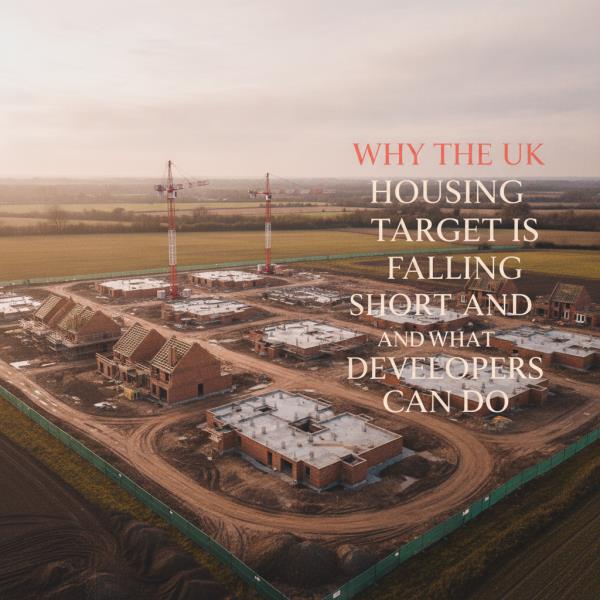
Why the UK Housing Target Is Falling Short and What Developers Can Do
The government's target of 1.5 million new homes by the end of this parliament is already looking out of reach. From planning delays and unaffordable development finance to a shrinking Build to Rent pipeline, this article sets out the real blockers, and what developers can do to navigate them.
The numbers are stark. From July 2024 to March 2026, approximately 342,100 new homes were added to England's housing stock — roughly 22.8% of the 1.5 million target set for this parliament. Weekly EPC (Energy Performance Certificate) data for new homes suggests delivery is running at around 200,000 homes per year on an annualised basis. To hit 1.5 million by the end of this parliament, the country needs closer to 300,000 completions a year. The gap is not a rounding error; it is structural.
The Specific Blockers Slowing Delivery
Several distinct problems are compounding each other, and understanding them separately is the first step to working around them.
- Gateway 2 legislation: The Building Safety Act introduced a mandatory Gateway 2 check, a planning gateway that requires building control approval before construction begins on higher-risk buildings. In practice, this is adding an average of 26 weeks to planning timescales on affected schemes, a significant drag on viability calculations and funding arrangements.
- Affordability constraints: Only 14% of homes in large towns and cities are affordable to single-income buyers at current prices and mortgage rates. That severely limits the depth of the market developers can sell into, particularly outside London and the South East.
- Development finance costs: Senior development finance is currently priced between 7% and 12% per annum depending on scheme size, location, and borrower track record. At those rates, margin compression is acute, and some schemes that would have been viable in 2021 simply are not today.
- Skills shortages: Persistent gaps in land acquisition expertise and quantity surveying are slowing the early stages of the development pipeline. These are not roles that can be filled quickly, and competition for experienced staff is intensifying as larger housebuilders seek to protect their own pipelines.
Build to Rent Is Contracting
Build to Rent (BTR) purpose-built residential schemes developed specifically for the private rental market — had been one of the more active parts of the construction pipeline in recent years. That is now reversing. BTR starts have fallen to their lowest level for almost a decade. Rising finance costs and uncertainty around rental regulation have combined to make new BTR schemes harder to underwrite. For the overall housing supply picture, this matters: BTR sites often deliver at scale and speed, so a contracting BTR pipeline has a disproportionate impact on completions in the medium term.
What the Government Is Offering
The government has committed £2 billion in grant funding for 2026/27, which Homes England estimates will support around 18,000 new affordable homes. That is a meaningful sum, but it needs to be set against the scale of the shortfall. Meanwhile, Savills has forecast that total completions will reach only around 166,000 by 2028/29 — substantially below even the current annualised rate, reflecting the time lag between starts and completions and the thinning of the forward pipeline.
The grant commitment will primarily flow through Homes England's Affordable Homes Programme. Developers — particularly registered providers and housing associations working in partnership with private developers, should be engaging with Homes England early if they are not already doing so. Grant allocations are competitive, and relationships matter.
How Developers Can Navigate the Current Environment
If you are a developer appraising sites or managing an existing pipeline, the current environment demands a more rigorous approach to viability than was necessary two or three years ago.
- Options appraisal: Run multiple scenarios different tenure mixes, phasing strategies, and density levels — before committing to a land price. Locking in at a price based on optimistic planning assumptions is the single most common cause of scheme failure in the current market.
- Affordable housing obligations: Section 106 negotiations (the legal agreements between developers and local authorities that typically require a proportion of affordable homes) are increasingly contentious. Build your viability case early, use a recognised appraisal methodology such as the Residual Land Value approach, and be prepared to engage the district valuer if necessary. Speak to your solicitor and planning consultant before entering negotiations.
- SME funding routes: If you are a smaller housebuilder, Homes England's Home Building Fund offers development loans and infrastructure funding specifically aimed at SMEs (small and medium-sized enterprises). The British Business Bank also has guarantee schemes that can improve your access to commercial development finance. These routes are underused by developers who are not aware of them.
- Homes England partnerships: For larger or more complex schemes, a strategic partnership with Homes England can unlock grant, loan, and land disposal opportunities that are not available through the open market. The application process requires time and resource, but the terms can significantly improve scheme viability.
What Better Planning Alone Cannot Fix
There is a widespread assumption that planning reform is the master key to the housing crisis. Planning reform matters, and the government's National Planning Policy Framework changes are welcome. But an improved planning environment cannot on its own resolve the finance cost problem, the skills shortage, or the structural gap in affordable housing delivery. It cannot rebuild a Build to Rent pipeline that has retreated due to regulatory uncertainty. And it cannot conjure the grant funding needed to make genuinely affordable homes viable at the scale required.
For developers, the practical takeaway is this: the sites that will get built in the next three years are the ones where the viability case is honest, the tenure mix is flexible, and the funding structure does not depend on conditions returning to 2021 levels. That is a tighter brief than many are used to, but it is the one the market is writing.
About this article: written by the Agreed team. We publish honest, hands-on guides on UK property based on what our associates and developer partners are actually doing day-to-day. Spot something out of date or wrong? Tell us via the contact page.